
ANOTHER WAY TO CREATE
The Start Where You Are Philosophy
A practical, compassionate approach to digital scrapbooking and art journaling
You do not need more time, better photos, or the perfect plan before you begin.
Take one meaningful step with the time, tools and energy you have today.
What Does “Start Where You Are” Mean
for Digital Scrapbookers and Art Journalers?
If you’ve ever stalled out on a scrapbook page because you didn’t feel ready, didn’t have the right supplies, or couldn’t find the energy to sit down and create — “Start Where You Are. Use What You Have. Do What You Can.” is for you. It’s not a productivity tip or a hustle mantra. It’s permission — permission to create from exactly where you stand today, with whatever time, tools, energy, and courage you have right now. Not someday. Not when things calm down. Today.
These nine words have become the foundation of everything I do as a designer, educator, and creative person. They shape how I teach, how I create, and how I talk to myself on the days when none of it feels easy.
Here’s how I found them — or should I say here’s how they found me.
On this page you’ll find
Where These Words Came From
It was late summer of 2019. I was halfway through recovering from pneumonia and really struggling to find my design mojo. I was deep in one of those stretches where the gap between what I wanted to create and what I had the energy to actually do felt enormous.
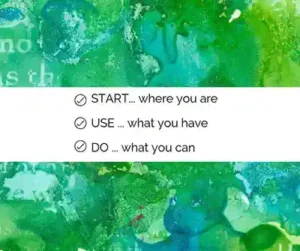 In the middle of me whining and feeling sorry for myself, a friend recited a quote — attributed to tennis legend Arthur Ashe — that hit me so hard I turned it into a little digital card, printed it, and taped it to my iMac.
Start where you are. Use what you have. Do what you can.
I thought it was a nice reminder. I didn’t realize it was about to become a lifeline.
Through the COVID years, some difficult family dynamics, my husband’s three back surgeries in 18 months, my own health challenges, and my father’s slow descent into dementia, I found myself coming back to those words again and again. Almost like a mantra.
And when my father passed away, I leaned on them once more for reassurance and grounding.
Those words don’t fix everything. But they do remind us that we don’t have to fix everything all at once — especially not just because the calendar has flipped or the world expects us to show up with fresh energy and bold intentions when we’re still tired from getting through the last season.
What This Philosophy Is — and What It Isn’t
Before I break down the three principles, I want to be clear about what this is and what it isn’t.
This is not advice. I’m not standing on the other side of some creative finish line telling you to try harder. I’m standing right next to you — I get stuck too. I’m saying, “Hey, I think we can take one small step from here.”
This is not about lowering your standards. It’s about refusing to let impossibly high ones keep you from starting at all.
This is not about productivity. You won’t find a system here, or a challenge with 30 days of prompts you’ll feel guilty about abandoning by day four.
This is about permission. Permission to begin before you’re ready. Permission to use what’s already in front of you. Permission to let “enough” be enough — at least for today.
And it applies to far more than scrapbooking. But for those of us who tell stories with photos and pixels or papers and brushes, it hits in a very specific way.
The Three Principles
1. Start Where You Are
This is the principle that unlocks the other two — because nothing else matters if you never begin.
“Start where you are” means your current skill level is a valid starting point. Your current energy is a valid starting point. Your messy, complicated, not-at-all-Instagram-worthy life is a valid starting point.
It means you don’t have to master the software first. You don’t have to wait until you feel more confident, more rested, or more caught up on the laundry. You don’t have to reach some imaginary readiness threshold before you’re allowed to open the program and put something on the page.
I know how tempting it is to wait. I’ve told myself every possible version of “I’ll create when … “
I’ll create when I learn the software better.
I’ll tell that story when I have more time to do it justice.
I’ll get back to it when life calms down.
But here’s what I’ve learned the hard way: that “perfect moment” has a habit of staying just out of reach. And the longer you wait for it, the heavier the gap between “where I am” and “where I think I should be” starts to feel.
Starting where you are is how you close that gap. Not by leaping across it — by taking one step from wherever you’re standing.
The beginner who has never opened the software can start. The experienced creator who hasn’t made a page in six months can start. The tired, grieving, overwhelmed human who isn’t sure any of it matters can start.
Not when everything lines up. Not when you finally feel confident. From right where you are, today.
2. Use What You Have
This is the principle that quiets the voice saying you need something else before you can create — a better kit, a newer tool, more photos, more time.
“Use what you have” means the supplies sitting in your digital stash right now are enough to make something meaningful. The photos on your phone are enough. The 15 minutes between dinner and bedtime are enough. The free software you downloaded to try this out is enough.
It’s not saying “settle.” It’s saying you don’t have to buy your way into creativity.
I know that — as a designer who sells digital supplies for a living — this might seem like a strange thing for me to say. But I’ve watched too many women accumulate hundreds of dollars worth of kits, brushes, and templates and still feel like they can’t start because they don’t have the *right* ones. The shopping becomes a substitute for creating. The collecting feels productive, but it’s not the same as making something.
Here’s what I’ve discovered, both in my own work and in watching others: **constraints are often the spark.** When you limit yourself to one kit, one photo, one font — when you shrink the sandbox — it’s actually easier to play. The overwhelm of too many choices disappears, and you’re left with just you and the page.
And there’s a deeper layer here for those of us who scrapbook and art journal. “Use what you have” isn’t just about supplies. It’s about your stories.
You don’t need a dramatic story to tell. You don’t need a once-in-a-lifetime trip or a milestone birthday or a picture-perfect holiday. The ordinary moments — the ones that feel too small to scrapbook — are often the ones your family will treasure most.
Use the stories you have. They’re enough, too.
3. Do What You Can
This is the principle that keeps perfectionism from eating you alive.
“Do what you can” means one simple page counts. Ten minutes of creating counts. A messy art journal background with no journaling counts. A layout that will never make it into a gallery but tells the story you needed to tell — that counts.
It doesn’t mean lower your standards. It means stop letting impossibly high standards be the reason you create nothing at all.
I’ve lived this one out loud. You may have noticed that lately, instead of releasing large kits or full collections, I’ve been sharing smaller, individual packs — and experimenting with different styles of art along the way. That’s not accidental. That’s me giving myself permission to do what I can, in the season I’m in, instead of waiting for the “right” moment or the “perfect” amount of energy.
Because here’s the truth about creative work: doing it imperfectly is how you learn to do it well. Every page you make — even the ones you’re not proud of — becomes part of your creative foundation. The skills build. The confidence builds. And one day you look back and realize the momentum came not from one perfect page, but from dozens of imperfect ones.
One simple page beats the elaborate spread you never make.
One messy art journal background beats the blank page that stares at you.
Ten minutes of creating beats two hours of thinking about creating.
The goal is momentum, not masterpiece.
Why This Matters So Much for Creative Women
There’s a reason these words resonate so deeply with women in our community — and it goes beyond scrapbooking.
Many of us came to this craft later in life. We spent years raising families, building careers, taking care of everyone else. And somewhere along the way, we lost the thread of our own creativity — or maybe we never picked it up in the first place.
Now we’re here, in a season where we finally have a little more time or space or desire to do something that’s just for us. And instead of feeling free, we feel behind. We feel like we should already know how to do this. We compare ourselves to people who’ve been creating for years. We wonder if it’s too late.
It’s not too late.
“Start Where You Are” is the answer to every one of those fears. You’re not behind. You haven’t missed your window. The perfect time to start is whenever you decide to start — and whatever you’re able to create from that starting point is worth creating.
Your stories matter. Your memories matter.
Preserving them doesn’t require perfection — it requires showing up.
Key Takeaways
✓“Start Where You Are” isn’t productivity advice — it’s permission to create from exactly where you stand today.
✓ Start Where You Are means your current skill level, energy, and life circumstances are all valid starting points.
✓ Use What You Have means your existing supplies, photos, and stories are enough — you don’t have to buy your way into creativity.
✓ Do What You Can means one imperfect page beats the perfect one you never make. The goal is momentum, not masterpiece.
✓ This philosophy matters especially for creative women who came to this craft later in life and feel like they’re behind. You’re not.
What This Looks Like in Practice
These three principles are more than a philosophy — they’re a practical framework for getting unstuck and staying creative, whether you’re brand new to digital scrapbooking, returning after a long break, or doing deeper work through art journaling.
I’ve written a companion post that walks through exactly how to apply each principle depending on where you are in your creative journey — with specific exercises, prompts, and “Try This” challenges you can do today.
Read: How to Apply “Start Where You Are” to Your Digital Scrapbooking and Art Journaling
🦋
Ready to Begin?
If you’re feeling stuck and would love a little company as you find your way back, Begin Anywhere is a free 7-day email series of gentle prompts to help you move past the blank page and return to your creative practice — whether that means a digital scrapbook page or an art journal page. No pressure. No perfection required. Just a kind little nudge from a friend who knows how hard it can be to begin again.
Want to Go Deeper?
Start Where You Are: A Creative Recovery Guide for Digital Scrapbookers is the book I wish someone had handed me during my own creative winter. Nine chapters, three bonus resources, and one simple promise: you’re not broken, this is temporary, and here’s how to start moving again.
🌿 Let’s Keep the Conversation Going! Be patient, though — comments must be approved before they will be shown below.
0 Comments