
Can You Scrapbook Without Photos?
Yes — you can absolutely scrapbook without photos. Memorabilia, maps, quotes, typography, sketches, and even an image from the era you’re remembering can all become the focal point of a page. The photo was never the point — the story is.
Maybe the pictures were lost in a move. Maybe they’re sitting in a shoebox at your sister’s house, or maybe that moment simply never got photographed. A reader once told me she always felt a page without her own photos wasn’t a “real” scrapbook page — like she wasn’t being honest about the subject. I understand that feeling, but I don’t agree with it. Your story deserves to be told, with or without a camera roll to back it up.
In an earlier post, I talk about the importance of documenting your own life, and I’ve also shared tips on finding the perfect photo for your scrapbook pages. But photos of friends, family, and vacation spots are nice to have — they aren’t required. Here are 10 ways to give your page a strong focal point when you don’t have a photo to work with.
10 Ideas for Scrapbook Focal Points Without Photos
1. Memorabilia
Tickets, postcards, letters, programs, report cards, recipe cards — the everyday paper of your life tells stories all on its own. Scan or photograph the item flat and use it the same way you’d use a photo. A concert ticket stub sitting next to your journaling about that night says more than you might expect.
2. Quotes
A meaningful quote can capture the emotion of a moment better than a picture sometimes can. Choose one that reflects how you felt, not just what happened, and let it take center stage. Pair it with a few kit elements in colors that match the mood.
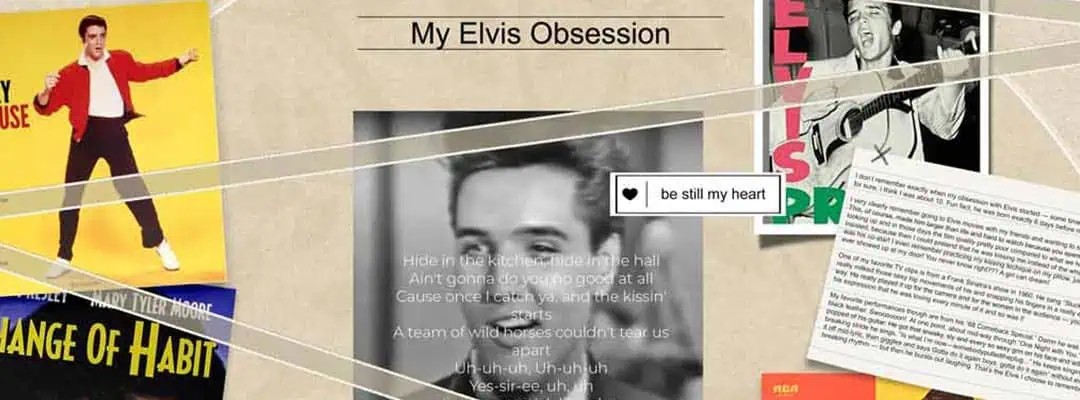
3. Images From the Era You’re Remembering
Use your favorite search engine to find images from the time period you’re scrapping about. You might find one that fits perfectly — and even better, whatever you find might spark ideas for more pages!
For this page about my younger self’s obsession with Elvis, I used images of his movies and songs. I also have early memories of our years in Brooklyn, New York, in the early ’60s, and I found images to help me tell that story too. Click through to see the full layouts:


4. Song Lyrics
Few things transport us back in time like music. A line or two from a song that meant something to you can instantly set the scene — the song that played at your wedding, the album you wore out in high school, or the hymn your grandmother hummed while she cooked.
5. Maps
If you’ve traveled a lot or moved around, maps are a wonderful way to document your journey. Mark the places you’ve lived, trace a road trip route, or zoom in on the neighborhood where you grew up. A map makes an especially strong focal point for heritage and family history pages.
6. Silhouettes or Sketches
Silhouettes of people (or even animals) and sketches — such as these — are great substitutes for photographs. They create a visual, yet generic, representation of the subject of your page, so your reader still has a “who” to connect with.
7. Typography and Word Art
Instead of relying on images, let the words themselves become the art. Experiment with different fonts, sizes, and colors to build a visually appealing title or journaling block. Pre-designed word art can also make an effective focal point when you want something polished without starting from scratch.
8. Stock Photos
While they won’t be your own personal memories, high-quality stock photos can set the mood beautifully. Look for images that match the feeling of your story — a rainy window for a reflective page, or a stack of old books for a page about a teacher who changed your life.
9. Handwritten Notes and Journal Excerpts
If you have notes or letters written by loved ones, adding their handwriting is one of the most touching ways to remember them. Even excerpts from your own personal journals can become the foundation of a layout — your younger self’s words carry a lot of weight.
10. Templates With Journaling in the Photo Spots
If you like scrapping with templates, simply replace the photo spots with your journaling, then use kit elements to add visual interest. It’s one of the easiest ways to turn a photo-focused template into a story-focused page.
A Quick Note About Sharing Pages Online
For pages you keep for yourself, use whatever helps you tell the story. If you plan to share a page in a public gallery, it’s a good idea to choose images that are free to use — sites like Unsplash and Pixabay offer free stock photos — and to keep song lyrics to a short line or two. That way you can share your work with confidence.
Is a Page Without Photos Still a “Real” Scrapbook Page?
Absolutely. The most important thing is to record the story. Any focal image that draws attention to your story is the perfect one. If you have photos you’re happy to share, wonderful — use them! But when circumstances are different, use your imagination and get that story told. The people who read your pages someday will care far more about what you remember than whether you had a picture of it.
Ready for Your Next Page?
Learning a new technique is the easy part — finding the spark to actually sit down and use it is another story. If you’ve been feeling stuck, Begin Anywhere is my free 7-day email series of creative prompts to help you get back to your pages, one small step at a time.
And if you’re ready to go a little deeper, visit Start Where You Are for practical guides to getting unstuck and making pages you love.
A lot of great ideas! I’ve used several and will have to try some more. TFS
I’m so glad, Jana! Thanks for stopping by website!
Wonderful ideas! Most importantly you validated, for me, that it is OK to use internet images or free photos to scrap a page. I always feel like it is not a “real” scrapbook page or that I am not being “honest” about the subject of the layout!
Hi Barbara! I know that many scrappers have that same sense when scraping without their own photos. My take on it is that the most important thing is to record the story. Any focal image you can use to draw attention to the story is perfect. Of course, if you happen to have photos you don’t mind sharing with the world, by all means, use them. But when circumstances are different, use your imagination and get that story told! Thanks for stopping by my website!
Great post, I love the ideas you give here.
Thank you for posting!
Thanks, Jeannette! Glad you enjoyed the post!